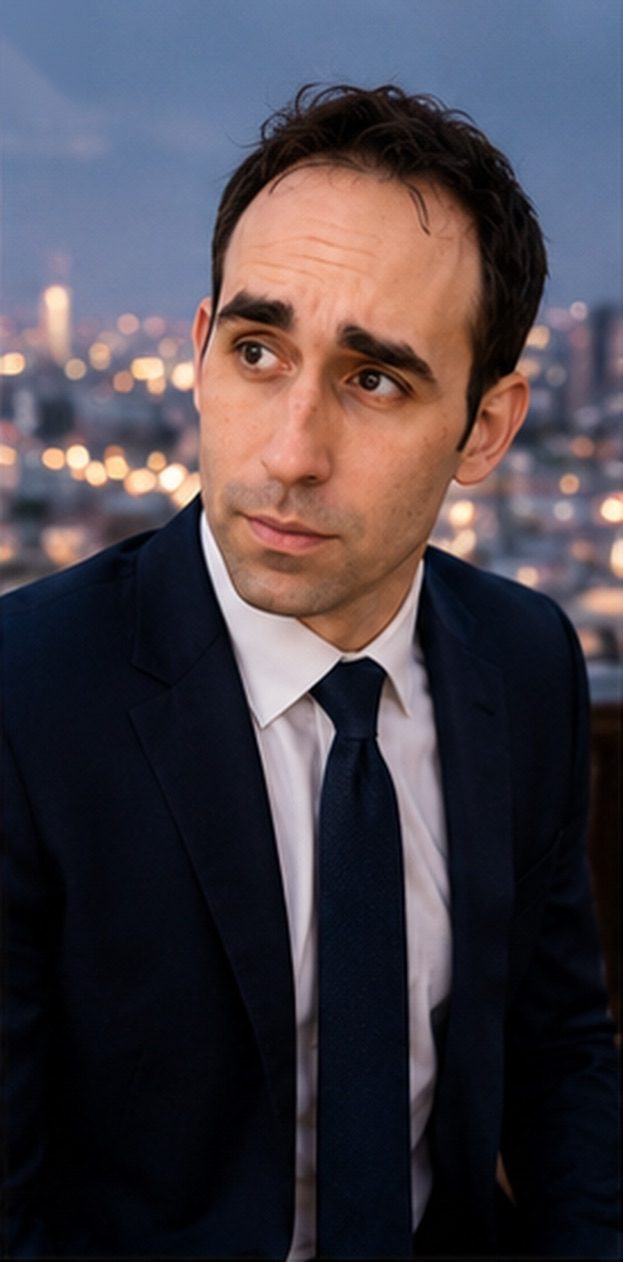
I used to think optimism meant believing everything would work out. I think it means realizing you still have choices.
The world is unfair, chaotic, and rarely interested in our plans. But I am reluctantly optimistic because we are not powerless. We can still build. We can still choose. We can still change the systems we live inside — including the ones we built ourselves.
This is the working notebook of someone trying to build more agency without pretending the mess is not real.
The Reluctant Optimist is about self-development, systems, philosophy, and honest ambition — for people who want to get better without pretending life is simpler than it is.
There are roughly two kinds of writing online about how to live: the kind narrated from the far side, once everything has been sanded down into a tidy lesson — and the kind written from inside the attempt, before anyone knows how it ends. This is the second kind. It is also the only kind I trust for very long.
For most of my life I ran on brute force — push harder, prove the doubters wrong, outlast everyone, turn the chip on my shoulder into motion. And it works, right up until you realize you can use it to build an entire life you never actually wanted and call it a win. I'm trying to do it differently now: to build things because the future genuinely pulls me toward them, not because I'm using them to silence someone. I haven't arrived. I'm working it out in the open, usually out loud, usually before I'm sure I'm right. That's the whole project.
Why "Reluctant Optimist"
Because optimism gets cheap when it asks you to stop thinking. I am interested in the kind that survives skepticism — the kind that can look directly at reality, admit what is hard, and still decide to build anyway.
I am hopeful. I am also not delusional. The hope comes from agency, not denial.
I do not think the world is secretly fair. I do not think everything happens for a reason. I think life gives people different starting points, different burdens, and different odds. But I also think most of us have more room to move than despair wants us to believe.
"There's no price for peace of mind."
— My mom
Why "the cage you built yourself"
Most writing about freedom is aimed at the W-2 worker — quit your day job, manifest the laptop life, escape the office, whatever. I understand why that message works. I also know it is incomplete.
The entrepreneur cage is often the one you built yourself. It looks nothing like the cubicle. The bars are made of ambition, responsibility, payroll, promises, identity, and all the decisions that once looked like freedom. Every wall is one you welded into place because at some point it seemed like a good idea.
That is why agency matters. Escaping one cage does not mean much if you immediately build a better-branded version of the same thing.
The point of this project is not to dismantle the whole thing. The point is to notice the bars. Then to see which ones I can quietly unscrew without burning the building down.
How I work — audio-first, written through
I don't sit down to write essays. Sitting down is when the writing gets performative. Instead I record — often on walks, often into the phone, often without knowing what I'll say until I'm a few minutes in. That part is the source. It's the voice with the breath in it.
Then I run the audio through AI. Not to polish, not to "improve" — to find the shape. To pull the line out of the meander. The AI doesn't write for me. It helps me see what I was actually saying. The thinking is mine. The shaping is collaborative. Every post ships with audio and write-up side by side.
You can read or listen. Or both. The truth, if there is one, lives somewhere between them.
What this is really about
One question, through several lenses:
How do we build more agency in a world we cannot fully control?
Essays. Ideas about identity, judgment, freedom, self-development, and what entrepreneurship actually costs — from inside it, not from the other side with a book deal.
Systems. Practical frameworks, exercises, routines, and tools for people who want to work and live more deliberately. Decision-making, focus, energy management, habits, and the structures that make a business — or a life — run without running you.
AI. Clear-eyed explorations of artificial intelligence, technological change, and what people should actually do next. Show the prompts. Show the experiments. Show what changed — and what did not. The bridge between "AI is amazing" and "here is how to actually live with it."
Experiments. The part where the ideas have to survive contact with reality. Some experiments will be business-related. Some will be personal. Some will be about systems, attention, relationships, tools, or habits. The point is simple: ideas should earn their confidence.
Who this is for
This is for people who value freedom, but have learned that freedom without self-awareness can become a new kind of cage. People building things, running things, rebuilding themselves, trying to make better choices without pretending the choices are easy. People who want to learn from anyone, even a five-eyed monster from the planet Trog, if the five-eyed monster from Trog has something useful to say.
If that's you — welcome. If it isn't, no harm done. The unsubscribe button works.
What this site is trying to be
This is self-development with the lights on. I am not here to pretend I have transcended the mess and returned with a perfect system. But I do care about growth, motivation, better questions, practical change, and the strange work of becoming someone you trust more.
Not because you are broken. Because you are building.
The newsletter is free and will stay free. What I am actually after is simpler than a business: I want this to be a place you can think next to. Not a stage I perform on and you applaud — more like sitting across from someone who is working the same problem you are, and saying the quiet parts out loud so they are easier to look at.
If you've made it this far
Most people won't. That's fine. The whole project is calibrated for the kind of reader who reads to the end of an About page — which is, broadly, my exact target audience.
If you want to read what gets published, the subscribe page is two clicks away. If you want to see what I am building, that is on the Tools page. If you want to say something back, the Contact page is real, and I read everything.
Not narcissistic enough to think you care. Delusional enough to think it matters.